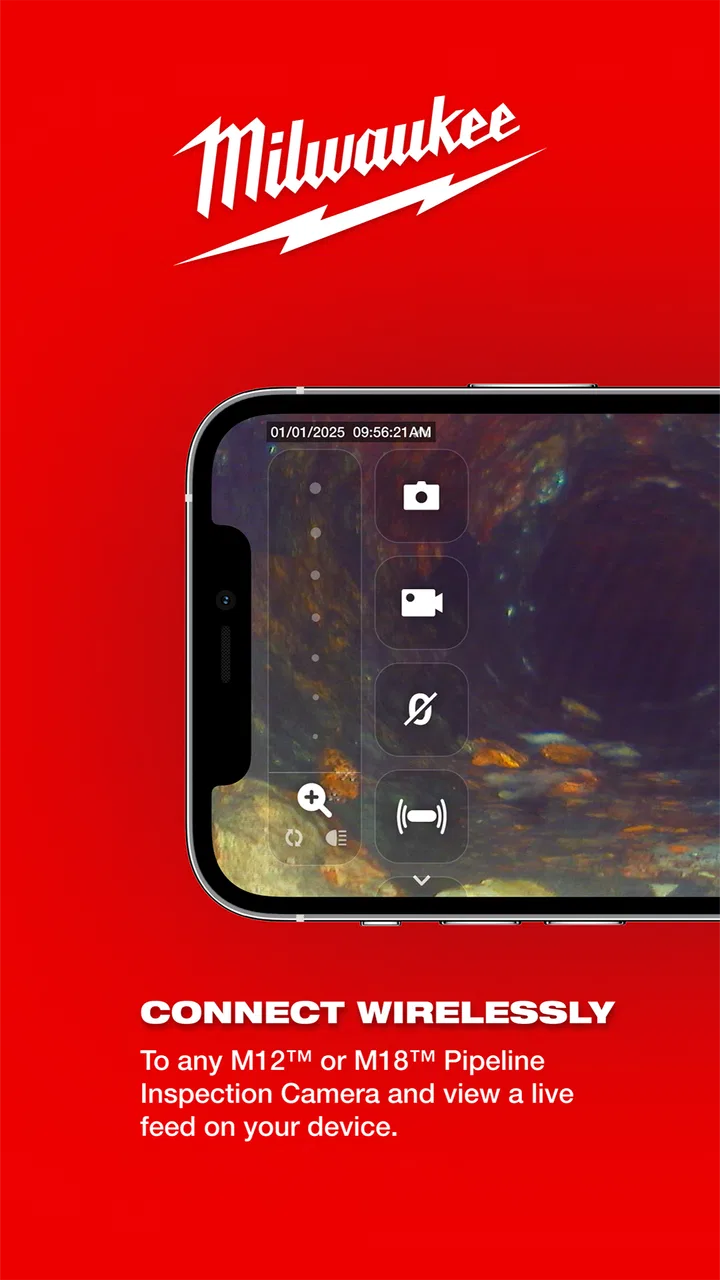
Milwaukee® Pipeline Inspection
- 3.5
- Rating
- 10.00K
- Installs
- Free
- Price

 Analysis by App-foxy
Milwaukee® Pipeline Inspection is a specialist Android app for people working with the Milwaukee pipeline inspection system, rather than a general home-maintenance tool. I approached it as a first-time user who wanted to understand where the app fits in a real inspection workflow, what happens after installation, and whether it offers enough value for occasional work or mainly suits professionals already using Milwaukee equipment. My overall impression is that its usefulness depends heavily on that equipment connection: when the app is part of your inspection setup, it can be a focused companion; without the matching hardware, there is little reason to choose it over a broader home and repair app.
The app is free and comes from Milwaukee Tool, a developer already associated with jobsite equipment. It has an Everyone content rating, so the listing presents it as suitable for a broad audience from an age perspective. Its store summary introduces it as the Milwaukee pipeline inspection system app, while the shorter store description simply identifies it as Milwaukee Pipeline. That concise presentation is important: this is not trying to be a tutorial library, a household inventory manager, or a general camera utility. It is a purpose-built entry point for pipeline inspection work.
What to expect before you install it
The first thing I would tell a friend is to treat this as an equipment companion, not a standalone inspection solution. The name points toward a workflow in which the phone or tablet works alongside Milwaukee’s pipeline inspection system. That changes the question from “What can this app do on its own?” to “How does it help me use the inspection system more effectively?” If you do not have access to the relevant Milwaukee setup, the app is unlikely to become useful simply because it is installed.
You May Also Like

 Pandora - Music & Podcasts
Pandora’s Music Is Easy to Start, but Harder to Recover
Pandora’s strength is its low-effort path from a seed to a station. Its weak spot is how much confidence it asks you to place in connection, setup, and quiet recovery.

 8 Ball Pool
 Is Built on Rivalries, Rematches, and Routine
A close look at the rivalries, rematches, shared routines, and unanswered safety questions that turn a quick pool match into a persistent mobile community.

 Samsung Music
’s Quiet Strength Is Playing What You Already Own
Its reach comes less from spectacle than from dependable access to a personal library. That simplicity is both the app’s strongest retention engine and its ceiling.

 AccuWeather: Weather Radar
AccuWeather Review: A Quick, Clear Forecast for Everyday Decisions
For everyday plans, the best forecast is the one you can understand quickly. AccuWeather makes rain timing, radar, and local conditions easy to act on, with a few trade-offs.

 Hill Climb Racing
Why Hill Climb Racing Still Turns Crashes Into One More Run
A tiny car, a bumpy hill and one more upgrade: Hill Climb Racing keeps resurfacing because its simple chaos makes every near-miss feel personal.

 AliExpress - Shopping App
AliExpress Makes Global Shopping Feel Personal, but Shoppers Bear the Risk
AliExpress turns a global marketplace into a pocket-sized discovery engine. Its reach is useful, its shopping loop compelling, and its trade-offs easy to miss.
More From Our News Desk
View All News


That narrow focus is also its main strength. A general-purpose camera app may be easier to open, and a notes app may be more flexible for writing down observations, but neither is designed around the needs of a pipeline inspection system. A specialist companion has a better chance of keeping the inspection task in one place. The trade-off is that it may feel bare or limited if you expect a broad toolbox with unrelated household features.
I would place it in the House & Home category only in the broad sense that pipeline inspection supports property maintenance and repair. In practical use, it feels closer to a professional field utility than to an app for decorating, cleaning schedules, or DIY inspiration. That distinction matters for expectations. Someone checking a blocked drain once at home may find the setup more specialized than necessary, while a technician or property professional may appreciate that the app stays focused.
The current version is 2.1.2, and the app supports Android 7.0 or later. That makes compatibility worth checking before planning a job around it, especially if the phone used on site is older or belongs to a shared equipment kit. The listing shows a 3.5 average from around thirty ratings and fourteen written reviews, with over ten thousand installs. I read that as modest adoption rather than proof that the app is either excellent or unreliable. For a niche tool, the more meaningful test is whether it fits your particular Milwaukee workflow.
Because it is free, there is no purchase decision to make before trying it. That lowers the barrier for a first test, but it does not remove the practical requirement of having the right inspection equipment available. I would install it before arriving at a job, not while standing beside an access point with a customer waiting. A short preparation check can prevent the most frustrating kind of failure: discovering that the phone, app, and inspection system are not ready when the work has already started.
Who will get the most from it
The best match is someone who already uses Milwaukee pipeline inspection equipment and wants the mobile side of the process close at hand. That could include a maintenance worker checking recurring drainage problems, a service professional investigating a line, or a property team that needs a repeatable inspection routine. The app is also worth considering for a small business that wants staff to use the same manufacturer-specific tool rather than improvising with unrelated phone apps.
I would be more cautious if your work is mostly visual note-taking. If all you need is to photograph a visible pipe, write a short comment, and send it to someone, a normal camera and messaging workflow may be faster. The specialist app becomes more compelling when the pipeline inspection system itself is central to the job. In other words, its value comes from the complete setup, not from the app icon alone.
First setup: make the first session less stressful
After installing it, I would begin with a controlled test rather than a live inspection. Keep the phone charged, make sure the inspection equipment is available, and open the app before you need to make a decision. The goal is not to explore every option at once. It is to confirm that the app opens comfortably on your device and that you can reach the part of the workflow you actually need.
A useful first-session habit is to separate phone problems from equipment problems. If something does not appear to work, do not immediately assume the app is defective. Check whether the inspection system is ready, whether the phone is the intended device for the job, and whether you are following the connection or operating sequence used by your Milwaukee equipment. This simple separation makes troubleshooting much clearer than repeatedly tapping the same control.
I also recommend doing the first test in a quiet place with a short, known inspection task. A real job often contains too many variables: poor lighting, awkward access, time pressure, and a customer asking questions. A controlled test lets you learn the app’s rhythm without those distractions. Once you know where the important controls are, the same process becomes easier to repeat in the field.
Do not judge the app solely by how quickly it reaches its first screen. Specialist tools often feel less immediately familiar than consumer apps because their interface is organized around equipment and work steps rather than casual browsing. Give yourself a few minutes to identify the main action, the current inspection state, and the point at which you can review what you have just done. That mental map is more useful than memorizing every label.
A practical preparation routine
Before a job, I would use a short routine: open the app, confirm that the phone is the one you intend to carry, have the Milwaukee inspection system nearby, and perform a quick test before moving into a difficult location. I would also decide in advance what counts as a successful inspection step. Is it reaching the area you need to examine, capturing a useful view, or completing a record that another person can understand? Defining that outcome prevents the app from becoming a distraction.
For shared devices, consistency matters even more. If several people use the same phone, leave the app in a predictable state and avoid changing settings casually during a job. I would keep a simple written team instruction beside the equipment, not because the app is necessarily complicated, but because a repeatable handoff reduces hesitation for the next user. This is one of the less obvious benefits of a focused companion: it can support a standard routine when everyone uses it the same way.
Another practical tip is to learn the app away from the most demanding part of the inspection. If the equipment is being used in a cramped or dirty location, the phone should require as little attention as possible. Practicing the sequence beforehand means you can spend your attention on the inspection itself instead of searching for controls with one hand.
Your first meaningful success
For a first-time user, success should not mean mastering the entire system. I would define it as completing one short inspection workflow from opening the app to obtaining a result you can interpret or share within your normal work process. Start with a location or test situation that is easy to access and unlikely to create confusion. The purpose is to learn how the app participates in the job, not to prove what it can do under the worst conditions.
As you work, pay attention to the handoff between the physical inspection system and the mobile screen. That is where a specialist app earns its place. If the phone helps you see, control, or organize the inspection in a way that is more direct than using separate tools, you have found the core value. If you find yourself switching constantly to the camera, notes, or messaging apps, that is useful information too: the app may not cover your whole reporting routine.
After the first successful action, pause and review the result before closing anything. A common mistake with field tools is to assume that completing an action automatically means the useful information has been preserved. I would check that the outcome is understandable, that you know where to return for the next inspection, and that any follow-up task is clear. This review step is especially important when the app is used by one person in the field and another person later needs to make a repair decision.
A realistic example would be a maintenance worker investigating a recurring drainage complaint in an apartment building. Before entering the service area, the worker opens the app, checks the inspection setup, and performs a short test. During the inspection, the phone serves as the mobile control point rather than an unrelated camera. Afterward, the worker reviews the result and explains the next action to a supervisor. The benefit is not simply having another app installed; it is reducing the number of disconnected steps between inspection and decision-making.
That workflow also shows where preparation pays off. If the worker waits until the equipment is already positioned in a difficult access area, even a small point of confusion can slow the job. Testing the app first turns the first meaningful success into a repeatable procedure. In my view, that is the right way to evaluate it: not by how impressive the opening screen feels, but by whether it makes the actual inspection sequence calmer and more consistent.
Where new users may get confused
The biggest possible confusion is assuming that the app should behave like a normal standalone mobile utility. Its identity is tied to Milwaukee’s pipeline inspection system, so the app may make more sense once the physical equipment and the mobile device are considered as one setup. If you install it without that context, the available workflow can seem too narrow. That is not necessarily a flaw, but it is a reason to avoid downloading it casually.
Another point of friction is knowing whether a problem comes from the app, the phone, or the inspection hardware. I would troubleshoot in that order: first check that the app is open and responsive, then confirm the phone is suitable and ready, and finally verify the equipment side. Change only one thing at a time. Restarting everything repeatedly can hide the cause and make a simple setup issue feel like a serious failure.
Field conditions can also make a good workflow feel awkward. A phone screen is not always easy to use while wearing work gloves, standing in a tight area, or moving between inspection points. I would prepare the controls in advance and avoid relying on the phone for unnecessary tasks during the inspection. The more attention the app demands for routine actions, the less attention remains for interpreting what the inspection is showing.
There is also a difference between inspection and reporting. A specialist companion may help with the inspection stage without replacing the communication habits your team already uses. If your final deliverable is a detailed customer report, you may still need another approved process for writing, storing, or sending that information. I would decide this before promising a client that the app alone will produce a complete report.
The moderate average rating suggests that experiences are not uniformly strong, although the small review pool makes broad conclusions risky. I would treat the app as something to test against your own equipment and responsibilities rather than relying on the rating alone. A technician who needs this particular Milwaukee workflow may find it useful even if a casual homeowner does not, while a professional with a different inspection system may have no practical reason to use it.
When another option is better
A regular camera app is the better choice for a simple visual record that does not involve Milwaukee inspection equipment. A notes app may be better when the main task is writing observations, measurements, or a parts list. A general maintenance app may suit someone who wants reminders, household records, and repair planning in one place. Those alternatives are broader, quicker to understand, and less dependent on a specific hardware ecosystem.
Milwaukee® Pipeline Inspection is the better choice when the inspection system is already part of your work and you want the phone-based portion to stay aligned with it. The trade-off is specialization. You gain a more relevant companion for that task, but you should not expect it to become your complete home-maintenance platform or your universal documentation system.
The next step after your first inspection
Once the first workflow feels familiar, I would create a simple personal checklist for repeat jobs. Include the order in which you open the app, prepare the inspection system, perform the initial test, review the result, and pass the information to the next person. This is more valuable than trying to remember every screen because it focuses on the points where mistakes are most costly.
For teams, the next step is to run the same short inspection with two users. Notice where the second person hesitates, then adjust the shared routine. This can reveal whether the app is genuinely easy to hand over or whether its usefulness depends on one experienced operator. That distinction matters for businesses, because a tool that works only when one person is present may not improve the wider workflow.
I would also keep the app updated through the normal app-store process and periodically repeat the basic test when the phone or equipment changes. The current version is 2.1.2, and compatibility begins with Android 7.0 or later, so an older shared device should be checked before it becomes the only device available for a job. This is a small administrative step, but it protects the more important goal: arriving ready to inspect rather than discovering a compatibility issue on site.
My final view is fairly clear. This is a focused, free House & Home app from Milwaukee Tool that makes sense primarily as part of the company’s pipeline inspection ecosystem. I would recommend trying it if you already use the matching system and want a mobile workflow that stays close to the inspection task. I would skip it if you are looking for a general plumbing helper, a household organizer, or a standalone camera-based inspection app.
The best reason to install it is not the download itself, but the smoother connection between Milwaukee inspection equipment and the person using it. Test that connection with a small, controlled job, learn the first successful sequence, and decide from there. For the right user, that practical fit matters far more than broad feature count; for everyone else, a simpler general-purpose alternative will probably be the more sensible choice.
FAQs for Milwaukee® Pipeline Inspection
01What is Milwaukee® Pipeline Inspection used for?
Milwaukee® Pipeline Inspection is designed to support professional inspection work in pipelines, drains, and other hard-to-reach areas. It works with compatible Milwaukee inspection equipment to help users view, document, and assess conditions remotely. The app is mainly intended for tradespeople, maintenance teams, contractors, and facility professionals rather than casual home users.
02Does the app work without Milwaukee inspection hardware?
The application may have limited usefulness without compatible Milwaukee inspection equipment. Its main functions typically depend on a supported camera, inspection system, or connected tool that sends visual information to the mobile device. Before downloading, check the official compatibility information for your specific Milwaukee product, because features, connection methods, and supported devices can vary between models.
03Can I save or share inspection photos and videos?
A key benefit of using Milwaukee® Pipeline Inspection is the ability to review inspection footage on a mobile device and, depending on the connected equipment and app version, capture or manage images and video from the inspection session. Saved files can be useful for reports, maintenance records, or communicating findings. Storage and sharing options may depend on your phone and operating system.
04Is Milwaukee® Pipeline Inspection free to download?
The app may be available to download without an upfront charge, but downloading it does not necessarily mean that all functionality is available on its own. The practical value of the application depends on owning compatible Milwaukee inspection hardware, and some equipment may require a separate purchase. Always review the current App Store or Google Play listing for pricing, supported platforms, permissions, and any regional differences.
05What permissions and phone requirements does the app need?
Because Milwaukee® Pipeline Inspection may connect to inspection equipment and handle recorded media, it can request permissions such as Bluetooth or nearby-device access, local network access, camera or microphone access, and storage or photo-library access. Requirements can differ between Android and iOS versions. Grant only the permissions needed for the features you use, and keep both the app and phone software updated for better compatibility.
Pros
- Provides detailed pipeline inspection data in one mobile workspace.
- Supports field teams with organized records and inspection tracking.
- Helps reduce paperwork during pipeline assessment workflows.
- Useful for coordinating inspection tasks across multiple team members.
- Designed for professional use in pipeline maintenance operations.
Cons
- May be difficult to use without pipeline inspection experience.
- Some features may require an account or company authorization.
- Performance can depend on the quality of the mobile connection.
- The interface may feel too specialized for occasional users.
- Compatibility with certain devices or field equipment may be limited.

Milwaukee® Pipeline Inspection
Gallery